The real choice isn’t Vegas, it’s detours
At 8:17 a.m., we hovered over Google Maps at the last In‑N‑Out in the Valley, watching two routes flip between 4:05 and 4:38 like a slot machine. The blue line promised speed, but every “quick stop” pin we’d saved added a quiet 10–25 minutes once you counted exit ramps, parking, and rejoining I‑15. Even the gas station coffee decision felt like a detour tax.
The real choice on an LA→Vegas weekend isn’t whether Vegas is worth it—you’re going anyway—it’s whether your breaks are true resets or just friction in disguise. A clean stop is one where the experience is the same length as the hassle: think a viewpoint with a nearby lot, or food you can order fast and eat in hand. A “bad” stop can look close on the map yet behave like a mini‑errand: walking ten minutes to a photo spot, waiting in a line that spikes at noon, then crawling back into the same traffic you tried to escape.
If you want 2–4 guaranteed-fun stops, treat them like appointments, not options. Pick one early (before the outlet crowds and midday heat), one that doubles as lunch, and maybe a sunset‑timed view if you’re not arriving during peak Strip check‑in. If a stop can’t reliably fit inside 30–45 minutes door-to-door, it’s probably not a break—it’s the start of a second trip.
Pick your direction before picking stops
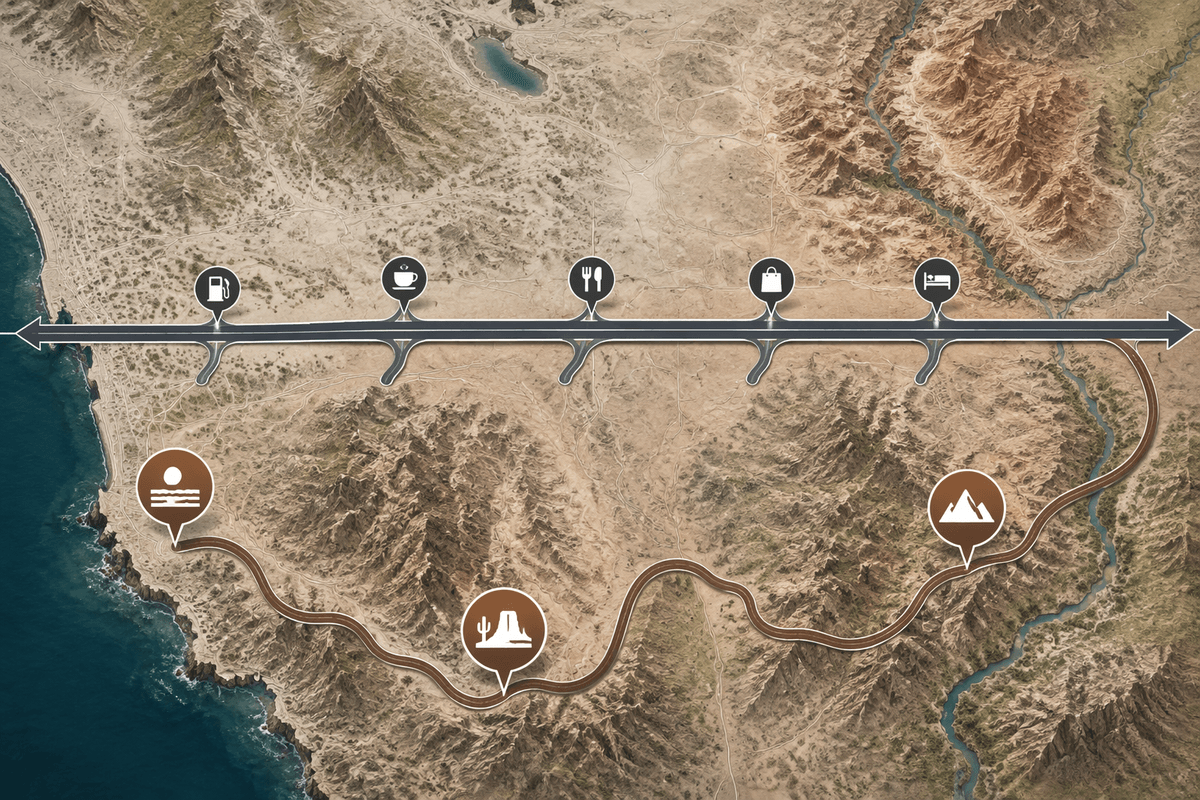
We hesitated right after the 210/15 split, watching the ETA jump as brake lights stacked up through Cajon Pass. Google pitched two temptations: stay on I‑15 and “sprinkle in” stops, or bail onto side roads that looked empty and clean. On a Friday morning, that choice isn’t philosophical—it’s whether your breaks live on the same spine as your drive.
Pick a direction first: the straight I‑15 corridor (fastest when traffic behaves) or a deliberate “desert texture” detour (slower, prettier, more stop-friendly). The I‑15 spine works best if you want 2–3 quick hits with minimal re-entry pain—think places where the parking lot is basically part of the exit ramp. The detour style only works if you’re okay trading a smoother pace for a longer clock: it can feel calmer than stop-and-go, but one wrong turn or a slow two-lane stretch turns your “break” into mileage you can’t win back.
For two friends trying to arrive functional, I’d commit to one lane of logic: either (A) “efficient” stops that sit within a few minutes of I‑15 and cap at ~30–45 minutes door-to-door, or (B) one big off-route stop you treat like an event, then no more improvising. Mixing both sounds flexible; in practice it’s how you end up hungry in Baker, staring at the sun, and bargaining with yourselves about whether the next pin is “basically on the way.”
Avoid the time traps locals warn about
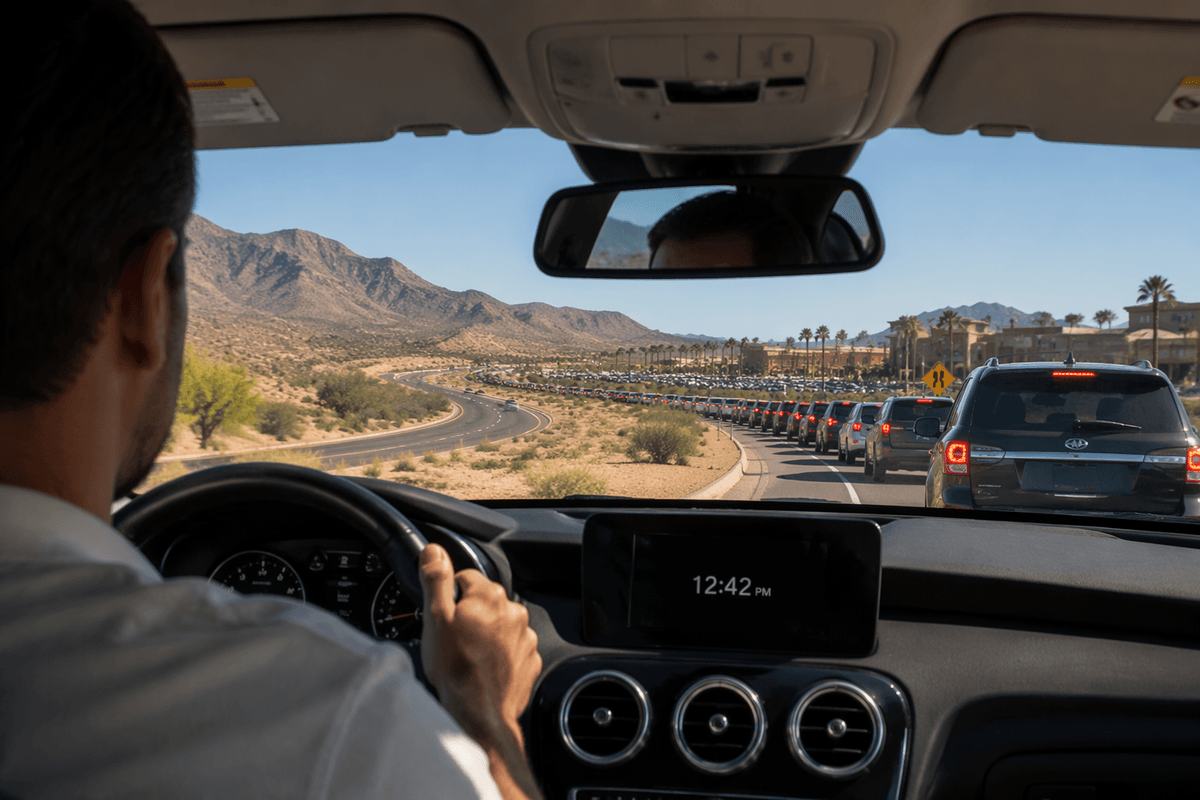
At 12:42 p.m., we watched a cluster of cars dive off I‑15 toward the outlet exits, then crawl in a slow loop that looked like a theme park queue with brake lights. We were tempted—air conditioning, snacks, “just a quick look”—but the clock said we’d hit Vegas check‑in traffic if we lost even 40 minutes. The detour didn’t look long; the re-entry line did.
The locals’ warning isn’t “don’t stop,” it’s “don’t stop where you can’t control the time.” Outlet malls and popular fast-food exits near Barstow/Victorville behave like funnels: you trade a clean 10-minute break for 25 minutes of parking-lot math, then another 10 just to get back onto the freeway. Same with anything that requires a left turn across traffic or a long walk from the lot—five minutes on the map turns into a mini-errand in the sun, and it doesn’t feel like rest.
For a mid-range, three-day-weekend run, protect three windows: (1) Cajon Pass timing—if you’re already in stop-and-go, don’t “reward” yourself with a stop that also has merges and lines; (2) lunch—pick a place where you can commit to either sit fast or grab and go, not somewhere that might trap you in a 30-person queue; (3) the last 60–90 minutes—avoid novelty stops then, because you’ll arrive more drained, not more amused. If a stop can’t promise “bathroom + payoff” within one song and a podcast segment, it’s probably the wrong break.
Build a tight route with minimal backtracking
At 1:18 p.m., we missed a “simple” coffee stop near Barstow because it required a left turn and a U‑turn, and the line of cars made it feel like we’d volunteered for a tiny commute. The pin was close, but the re-entry ramp wasn’t. That’s when the route stopped being about distance and started being about how many times we forced ourselves to cross traffic and re-solve parking.
A tight LA→Vegas plan looks boring on a map: you cluster needs (bathroom, caffeine, food) into the same exit, then you choose exactly one stop that’s purely for fun. Compared to four “quick” roadside pulls, two deliberate exits usually saves 30–60 minutes because you’re paying the merge-and-parking tax fewer times. You’ll pass tempting signs—but it works best for pairs who’d rather arrive with energy than collect random receipts and sunburn.
Practically, build it like this: one early right-off-the-freeway stop before you’re hungry (15–25 minutes door-to-door), one lunch reset where you can either sit fast or grab-and-go (45–60), and a single photo/view stop later only if your ETA still lands before peak check-in traffic (20–35). Keep each stop on the same side of I‑15 as your exit whenever possible; a “two-minute” cross-over is the kind that turns into ten. If you’re debating a third detour while already tired, that’s usually your cue to just keep rolling.
If I had one day, I’d do this
At 7:38 a.m., we were already rolling with a lukewarm coffee and the uneasy feeling that Cajon Pass would decide our whole day. The speed limit looked generous; the brake lights didn’t. I set one rule before the first exit sign: no stop that required “just a quick left turn” across traffic or a parking-lot loop.
If I had one day to do LA→Vegas with guaranteed-fun breaks, I’d cap it at three exits max and treat the last hour like protected time. Stop 1 is purely functional and early—gas + bathroom + a stretch—kept to 15–20 minutes door-to-door, because a “cute” first stop is usually just friction while you’re still fresh. Stop 2 is the only real experience: either Calico Ghost Town (worth it if you want photos and don’t mind the short detour) or Peggy Sue’s 50’s Diner in Yermo (works better if food is the mood and you want predictable seating). Both beat stacking two random roadside pulls that each cost a merge.
Stop 3 is optional and timing-dependent: if your ETA still lands before peak Strip check-in, do Seven Magic Mountains for a 20–30 minute sunset-ish photo hit; if you’re running late, skip it and arrive with energy. The clean decision cue: if you’re debating a fourth stop, you don’t want a stop—you want Vegas.