Stop planning trips; plan your system
I hovered over a color-coded Google Doc at 11:47 p.m., staring at a perfectly reasonable 9:10 a.m. connection and still feeling that familiar “something will go wrong” itch. The flight was booked, the hotel confirmation PDF was somewhere in my inbox, and I was comparing two train routes like it was a final exam. That’s usually the moment I realize I’m not “planning a trip” anymore—I’m trying to pre-solve life.
The useful shift is smaller than it sounds: plan a system, not the days. Trip-planning is bespoke every time (new neighborhoods, new transit quirks, new opening hours), so it invites rabbit holes; a system stays the same and catches repeat failures—missing a check-in window, landing with no cash plan, paying for the same bag twice because the airline’s rules changed between booking and the airport. It works best for mid-budget trips where you want savings and certainty on the big stuff (flights, first/last night lodging) but still want afternoons that can flex around weather, crowds, or fatigue.
A system means committing to a few boring decisions early, so you don’t burn prime hours later. I’d rather spend ten minutes standardizing where confirmations live and how I check entry rules than spend day one in a hotel lobby hunting for a booking number on spotty Wi‑Fi. If you hate overplanning, good—this isn’t more planning, it’s fewer avoidable surprises.
The one tip: a reusable travel checklist

At 6:18 a.m., I was on the airport Wi‑Fi refreshing an airline app that suddenly wanted my passport details again, even though I’d entered them the night before. The line at bag drop moved faster than my inbox search, and I could feel that stupid time tax building. It wasn’t a “planning” failure—it was a repeatable oversight.
If I had to pick one travel habit that actually moves the needle, it’s a reusable checklist you run the same way every trip. Not an itinerary, not a packing manifesto—just a short, living list that forces the unsexy confirmations: where the booking numbers are saved, what the airline considers a “personal item,” whether you can check in 24 hours out or 48, and what you’ll do if your phone dies mid-transfer. It’s the difference between flexible days and flexible logistics, and they’re not the same.
You’ll spend 10 minutes “checking boxes” when you’d rather browse neighborhoods. In return, you buy back decision energy on travel days—when crowds, delays, and fatigue make tiny mistakes expensive. This works best for 7–10 day trips where you’ve locked flights/hotels early but keep daily plans loose; if you’re doing ultra-minimalist one-bag weekends, the list can be shorter, but it still pays for itself.
Build it once in 20 minutes
I opened a blank note at my kitchen table with a coffee that was already going lukewarm, and I gave myself one constraint: 20 minutes, timer on. No design, no cute categories—just the last trip’s pain points, typed fast. It felt a little too plain compared to my usual “research mode,” but that was the point: if it can’t be built quickly, it won’t get reused.
Start by pulling artifacts, not ideas. Search your inbox for “confirmation,” open the airline app, and look at your last few receipts—those are the recurring failure surfaces. Your base checklist should be mostly logistics: where you store booking codes (one place), your check-in window, baggage rules you actually paid for, airport-to-hotel plan with a fallback (cash/ride-share/transit), and a “dead phone” plan (offline maps + one important number written down). Keep packing minimal here; a giant list becomes a guilt generator and you’ll stop running it.
You’re standardizing decisions that vary by airline and city, so you have to write prompts instead of answers: “Verify bag size for this carrier,” not “Pack carry-on.” It works especially well if you travel tired after work or land late—when lines are long and your patience is short. If you’re the type who loves improvising everything, make it even smaller: ten bullets you’ll actually read, not forty you’ll ignore.
Run it at three key moments
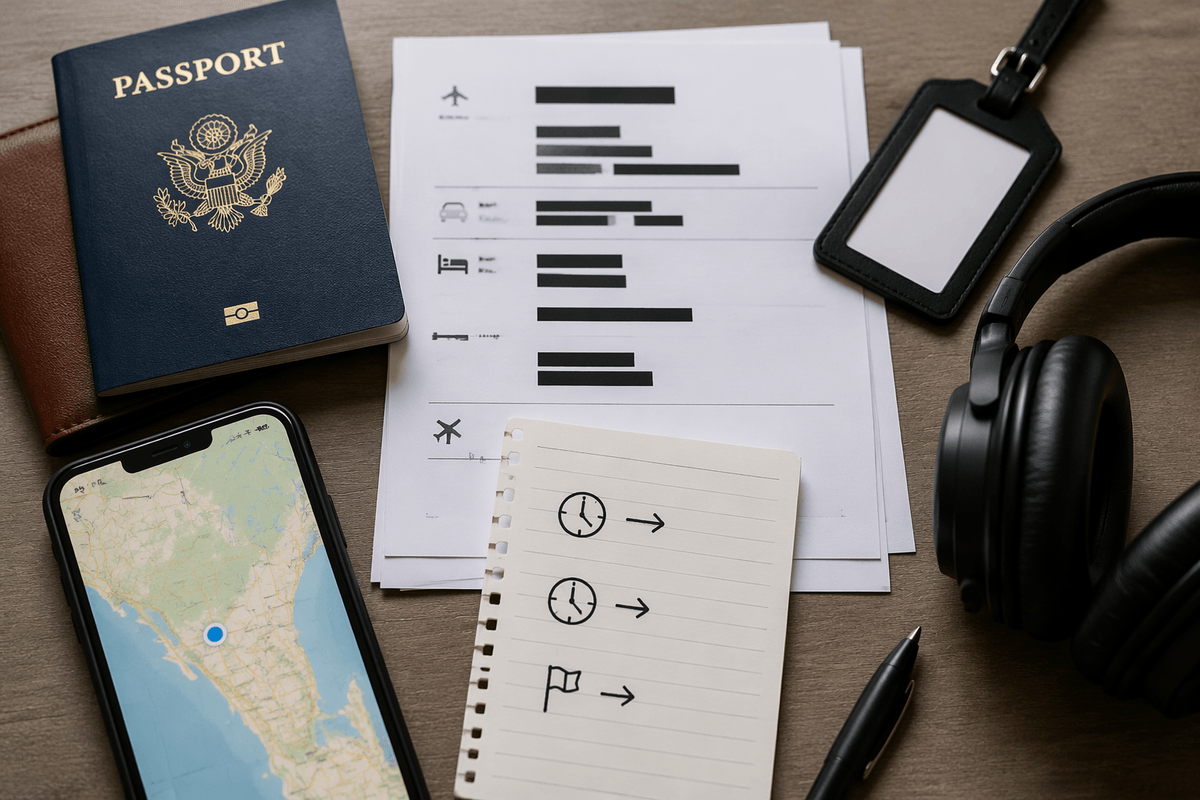
At 9:32 p.m. on a Tuesday, I hit “Purchase” on a flight and immediately wanted to close every tab and call it done. That’s exactly when the checklist earns its keep, because the cheapest mistakes happen right after booking—when you still have cancellation windows, seat maps, and baggage options in front of you. Waiting until the night before turns a five-minute fix into a support-chat problem.
I run mine at three moments, and I keep it short enough to survive real life. Moment one is post-booking (same sitting): save all confirmation codes to one place, screenshot anything you’d hate to re-find, and sanity-check the “shape” of the trip (late arrival vs early check-in, tight connection vs relaxed). This is where you choose certainty over spontaneity on the boring stuff—like paying for the right bag once—so you don’t bleed time later.
Moment two is T-minus 48–24 hours: online check-in window, seat assignment, entry/ID requirements, and a quick look at strikes/weather that could force a reroute. Moment three is travel day / landing: offline maps downloaded, first transport option plus one fallback, and the one phone number you’d want if your battery dies in a crowded terminal. If you’re a loose planner, this rhythm works because it protects flexibility where it matters (days) while tightening the screws where improvisation is expensive (transfers, fees, and fatigue).
My quick-start checklist for next trip
I was halfway through booking a “non-refundable” hotel when the payment screen flashed a different currency and a new line for “service fee,” and I just stalled with my finger over Confirm. Ten minutes earlier, I felt flexible; now I was doing mental math and trying to remember where I’d saved the flight code. That little friction is where I want a checklist to step in—faster than my mood can sour.
Here’s my quick-start version for your next trip—short enough to run on a phone, specific enough to prevent the usual time leaks. Post-booking (same sitting): save all confirmation codes in one place; screenshot the “rules” page (bags, cancellation, check-in time); sanity-check timing (arrival vs check-in, connection vs sprint). T-minus 48–24 hours: confirm check-in window; seat/bag status matches what you paid for; download offline maps for airport + hotel area; note one disruption trigger (storm, strike, construction) and your simplest reroute. Travel day/landing: have a dead-phone fallback (one key number written down); first transport option + one backup; small cash plan if cards fail. The trade-off is committing to a few boring choices early so you don’t improvise under crowd pressure.
If you’re a mid-budget, 7–10 day traveler, this is the sweet spot: it locks logistics without turning afternoons into a spreadsheet. If you’re truly spontaneous, cut the list in half—but keep the “single source of truth” for confirmations and the dead-phone plan. Next time you book, run only the post-booking slice before you close the tabs; if it feels like mild overkill, that’s usually the correct amount.