You want bond-like income, markets won’t cooperate
The search usually starts the same way: a bond ladder matures, the money rolls into “safe” cash, and the new yields don’t feel like enough for what retirement spending now costs. Meanwhile, the market keeps doing the one thing that makes committing to long-term fixed income uncomfortable—rates jump, prices slide, and every headline makes duration feel like a trap. The expectation is simple: find something that pays like a bond without getting punished when markets lurch. The friction is that the menu of plain choices is narrow, and the appetite for equity risk hasn’t suddenly returned.
That’s when a structured note shows up in the conversation, usually framed as “income with a buffer.” It sounds like a workaround for uncooperative markets, but it’s also a sign that the easy trade has already disappeared. The next step is to pin down what “income” actually depends on—because in these notes it’s rarely unconditional, and the path matters as much as the endpoint.
The brochure promise: high coupon with “protection”
The pitch tends to arrive as a neat term sheet: a headline coupon that looks 2–4× a Treasury, paid monthly, and a sentence that sounds like insurance—“10% downside buffer,” “30% protection,” or “principal protected if the index stays above the barrier.” In the meeting, it gets compared to a CD, but with “equity-linked income.” The pressure point is timing: you’re being asked to commit for a year or two right when rates and equities both feel jumpy, so the promise of paid-to-wait is doing a lot of work.
Look closely at how that “protection” is manufactured. It’s typically conditional: the coupon may stop if the index ever closes below a barrier on an observation date, or the principal protection only applies if the final level is above a knock-in level. The higher coupon is the trade for giving up something else—usually upside beyond a cap, participation in a rebound after a drop, or flexibility to exit without a haircut.
Then there’s the quiet line item: the bank can often call the note away if it’s working in your favor. So the best-case path tends to be short-lived, while the worst-case path is allowed to run to maturity.
Build a simple payoff example you can follow

To get past the headline coupon, it helps to reduce the note to one clean set of terms and pretend you’re buying $100,000 face value. Say the underlying is the S&P 500 price return index, maturity is 18 months, and the note pays a 10% annual coupon (0.833% monthly) as long as the index is at or above 70% of its initial level on each monthly observation date. There’s also a “barrier” at 70% at maturity: if the final index level finishes below 70% of start, you’re treated as if you owned the index from day one on the downside (principal loss is tied to the full drop from the initial level, not just below the barrier).
Now add the feature that usually gets skipped in conversation: the issuer can call it on any monthly observation after month 6 if the index is at or above its starting level. If called, you get par back plus the coupon accrued to that point, and the trade is over. In other words, your upside is mostly “coupon only,” your downside is equity-like once the barrier is breached, and your best path is the one the bank is most likely to end early.
Run three market paths and tally outcomes
Put that $100,000 into three simple paths and the shape of the trade shows up fast. Path A: the index drifts up, sits above its start by month 7, and the issuer calls. You collect about 7 months of coupons (0.833% monthly) or roughly $5,800, then get par back. The frustration is reinvestment: the note ends precisely when it’s behaving, and you’re shopping again in whatever the new rate/tape looks like.
Path B: the index chops around—never below 70% on observation dates, but also never cleanly above the start after month 6. No call, coupons keep paying. Over 18 months you’d tally roughly $15,000 of coupon and get $100,000 back at maturity. It feels bond-like, but it’s conditional on monthly closes you don’t control, and you’re still locked in unless you accept secondary-market haircuts.
Path C: a drawdown pushes the index under 70% near maturity and it finishes at 60% of start. Coupons likely stop on the months that observe below 70%, and the maturity payoff is equity-like: principal comes back around $60,000. That’s the same drop the “buffer” was supposed to make feel remote.
Where expectations break: calls, caps, missed rebounds
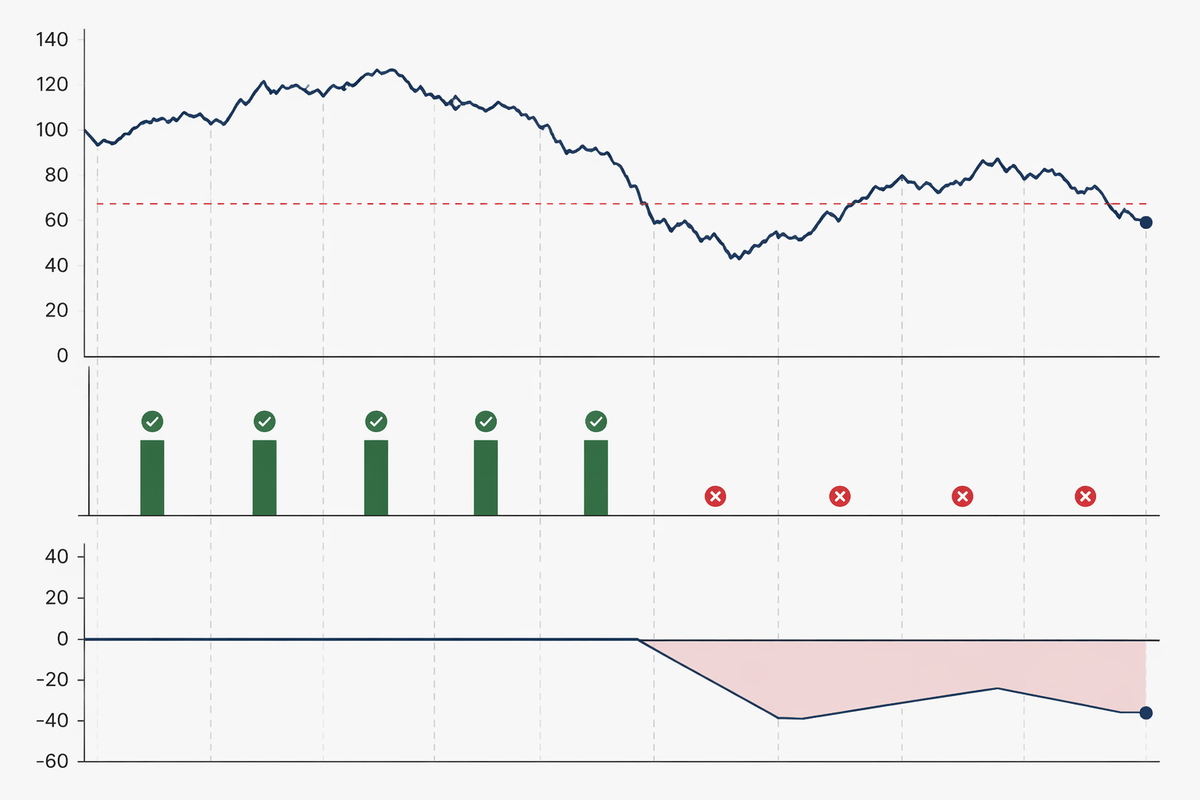
After you run those paths on paper, the mismatch shows up in the fine print, not the math. If markets are “okay,” the call feature quietly turns your best scenario into a short holding period. You’re not compounding 10% for 18 months; you’re often earning 10% for 7–9 months, then reinvesting when the bank has decided the trade is no longer attractive to it. The coupon was real, but the duration you thought you were buying wasn’t.
If markets are “good,” the cap is the other leak. The note is designed to monetize volatility, not to let you participate in an equity run. You may watch the S&P 500 climb 15–20% while your outcome stays “par plus coupons,” then gets called away before a second strong year can accrue. That’s not a disaster, but it’s a different bet than the brochure comparison to a bond implies.
If markets are “bad then better,” the barrier does the most damage to expectations. A single period below 70% can shut off coupons, and a late rebound doesn’t necessarily restore what you missed—because the maturity test can still leave you with stock-like downside if the final level is under 70%. The note can skip the pain of small drawdowns, yet still miss the rebound that usually compensates equity risk.
The risks you didn’t price in at purchase
By the time the term sheet feels “clear,” the risks that matter are mostly the ones that don’t show up in the payoff sketch. The first is issuer credit: you’re not holding the S&P 500 or a segregated pool of collateral, you’re taking unsecured exposure to the bank. In a stress event, the barrier math becomes secondary to recovery value, and the “income” you collected doesn’t compensate for a bad balance-sheet outcome.
Then there’s liquidity and valuation. If you need out early—tax bill, house purchase, simple regret—the bid is usually whatever the dealer will make in that moment, and it can be meaningfully below “fair” even if the index hasn’t moved much. Layer on that the coupon is partly funded by embedded options and hedging costs; you paid for the structure up front, but you only discover the size of that drag when you try to exit or compare it to a plain bond held to maturity.
Revised thinking: a checklist against bonds, CDs, ETFs
At this point the decision usually stops being “is 10% attractive?” and turns into a short checklist that forces the note to compete with simpler tools. First: if the bank calls in month 7, is that reinvestment risk acceptable, or would a 6–12 month Treasury/CD ladder do the same job with fewer moving parts? Second: if the index ends at 60%, can you live with equity-like principal loss while also having missed coupons along the way?
Then compare friction: expected hold-to-maturity, secondary-market haircut if plans change, and whether you’re being paid enough for unsecured issuer credit. Finally, ask what you’re giving up versus an ETF: daily liquidity and full participation in rebounds. If those trade-offs feel too expensive, the “high coupon” stops looking like income and starts looking like pre-sold upside.


![Revolut <18 vs. GoHenry [Which Card is Better?]](static/image/2026/07/27/c4c57026-ec22-4205-ab23-bb45d5fbc986.png)